


Technology Portfolio
Optical engineering is applied across Lens, Mobility, Display, LiDAR, Camera, Drone and Robot.
Lens
Lenses and optical parts are made through optical design, tooling, ultra-precision machining and injection. Mass-production details continue on Optical Components.

Silicone rod lens
Surface roughness, form accuracy and transmittance are secured, and yellowing is suppressed in high-heat LED environments.
- Optical efficiency > 60%
- 100 rods
- Ø9.65 mm
- Silicone

Multi TIR lens
Total internal reflection reduces light loss, and center and spread performance are balanced together.
- 7-up TIR
- PC

Double-shot lens
Thick lenses are mass-produced without shrinkage. Sink marks are prevented and cycle time is reduced.
- Thickness < 33 mm
- PMMA

Micro-pattern lens
Optical design, machining and evaluation of micron-scale patterns are in house.
- Pixel 0.5 μm
- Surface roughness < 20 nm
- PMMA

Fly Eye lens
Used in automotive headlamps and slim projection, with precise control of the focus of multiple lenses.
- Aperture < 15 mm
- Optical efficiency > 50%
- PMMA

Freeform Micro Optics
Slim design and high luminance are achieved together. Asymmetric micro patterns form the beam pattern and the image.
- Cell < 1 mm
- High beam · low beam · ADB
- PMMA

Ultra-precision glass lens
Chalcogenide, cylindrical, aspheric mold and anamorphic lenses are made to a high-accuracy form.
- Ra ≤ 10 nm
- P-V ≤ 0.5 μm
- Ø3–65 mm

Concave mirror
HUD mirrors are designed to the curvature of the windshield, and thin-film coatings are validated to automotive reliability criteria.
- HUD
- Thin-film coating

Light guide
Light lines for headlamps and rear lamps, interior ambient lighting, and power-tailgate drive guides are precision molded.
- PC
- PA6-GF30
Mobility
Headlamp optics, road projection and charge-port lighting are developed together with the design tools.

Multi TIR headlamp
Beam optics are designed in SPEOS, LightTools and CODE V, and the road beam pattern is validated.
- SPEOS
- LightTools
- CODE V

HD Micro headlamp
A compact optical system, lens holder and thermal structure are built as one module.
- Micro-LED
- 4 lenses

Motorcycle headlamp
Optical and mechanical design is carried out for a two-wheeler lamp package.
- LucidShape
- CATIA

DMD headlamp
The optical system and thermal structure of a DMD intelligent headlamp are designed.

Road-projection lamp
Stop patterns, real-time driving information and nighttime pedestrian guidance are projected onto the road.
- Static
- Dynamic
- Semi Dynamic

Fuel-filler and charge lamp
Buttons and lighting are integrated by IML, with nighttime visibility and heat and durability performance.
- IML
Mobility Display

Windshield projection
A WDP module integrating optics, mechanics, thermal design and circuits is supplied. Active Alignment raises efficiency and reduces image distortion.
- WDP
- Active Alignment

PGU
A DLP optical module for HUD. Lens, reflector, housing, heat sink and circuits are integrated, and assembly tolerance is reduced to secure sharpness.
- HUD
- DLP
LiDAR
Transmit and receive optics, optical-axis alignment and performance evaluation are developed for ToF LiDAR.

ToF LiDAR module
Tx and Rx optics are optimized, with optical-axis alignment and a performance evaluation system.
- 320×240 @15 fps
- 10 m
- 20° FOV

Tx lens
Spherical and aspheric combinations set beam uniformity. Plastic and silicone aspheres secure low weight and heat resistance.
- 2G1 Silicon
- 2G2P
- 3G4P

Rx lens
Collection is designed so light gathers on the sensor, and an IR band-pass filter reduces sunlight and stray light.
- 2G2P + BPF
- 3G4P + BPF

Active Align
Tx aligns the optical axis on 5 axes and inspects the beam and LED position. Rx aligns the lens and sensor, then completes UV bonding, cure and image inspection in one process.
- 5-axis
- UV bonding
Alignment accuracy
| Item | Specification |
|---|---|
| Aiming (X-Y Tilt) | ±0.05° |
| Aiming (X-Y Horizontal) | ±0.01 mm |
| Resolution | ±0.025° |
| Aiming Repeatability | within ±0.1° |
| Alignment Accuracy | ±6 Pixel |
Lens development history
- 2019–2021RX 20°, 90°
TX 2G1 Silicon - 2022–2024RX FBL 3.46 mm, FOV 126.8°, MTF ≥80% @940 nm
TX transmittance ≥90% (930–950 nm), 2G+Diffuser - 2025RX EFL 2.77, 125°, 2G2P+BPF, TTL 32.1
TX EFL 3.94, 125°, 2G2P, TTL 32.2 - 2026–RX EFL 2.32, 190°, 3G4P+BPF, TTL 21.98
TX EFL 1.54, 190°, 3G4P, TTL 28.63
Camera
Camera modules for vehicles, autonomous driving, robots and motorcycles are developed to the channel count and interface.
Vehicle monitoring

DVRS 5-channel camera
Front, rear, left, right and cabin
- 2M
- 8M
- G-sensor
- Mic
- ToF
- Radar
- Serdes

RGB-IR camera module
Cabin monitoring
- 2M
- GEO ISP
- 940 nm IR
- Serdes
- NVIDIA NX
Autonomous driving

Autonomous-driving camera, 5 channels
- 2M
- Serdes

Camera for image data collection
- 2M
- MIPI

Stereo camera
- 3M × 2
- Serdes
- NVIDIA NX
Robot and motorcycle

Autonomous robot camera, 7 channels
- 3M
- Serdes
- NVIDIA NX

Motorcycle dashcam, 2 channels
- 5M
- TVI
Evaluation environment

Image quality is checked in a darkroom with lighting conditions held fixed.
- Focus, distortion, illuminance uniformity
- MTF, SFR, color reproduction, white balance
- IMATEST, ISO charts
Drone
Drone lighting
UV, VIS, IR, SWIR and laser are used for object recognition, and coverage and brightness change with position, distance and environment.
- UV · VIS · IR · SWIR · Laser
Drone camera
A high-resolution sensor and a compact, lightweight, low-power structure match the payload, with reliability considered for vibration, shock and temperature.
- Lightweight
- Low power
- IP
Applications: security and surveillance, inspection and monitoring, surveying and mapping, promotion and broadcast.
Robot

Precision gear
Precision molds and metal-insert molding for ultra-compact, ultra-light reducer gears for humanoids and physical AI reduce weight and raise durability.
- Reducer gear
- Metal insert

Actuation gear
A CFRP housing, metal shaft and bearings are integrated in one process inside an ultra-compact space. Motor support is maintained in continuous operation.
- CFRP housing
The business introduction to composite tooling and molding is on Composite molds.
Certifications
Designations in materials and components, technology innovation, and root technologies.
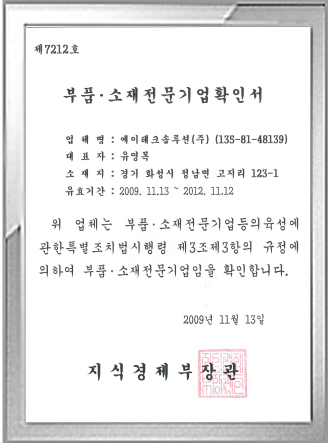
Materials and components specialist
A specialist in component development based on technical capability
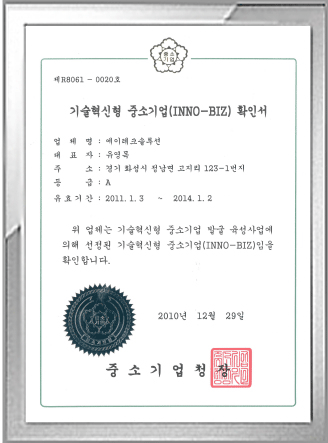
INNO-BIZ
Technology-innovation company certification
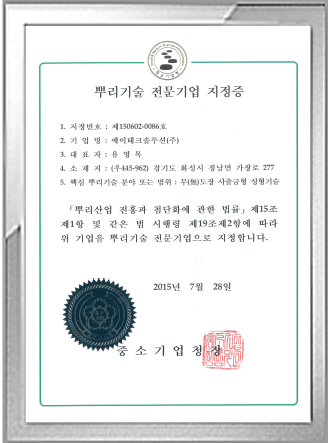
Root-technology specialist
Designated root-technology specialist company
Quality, environment and safety certifications and awards are on R&D Performance.